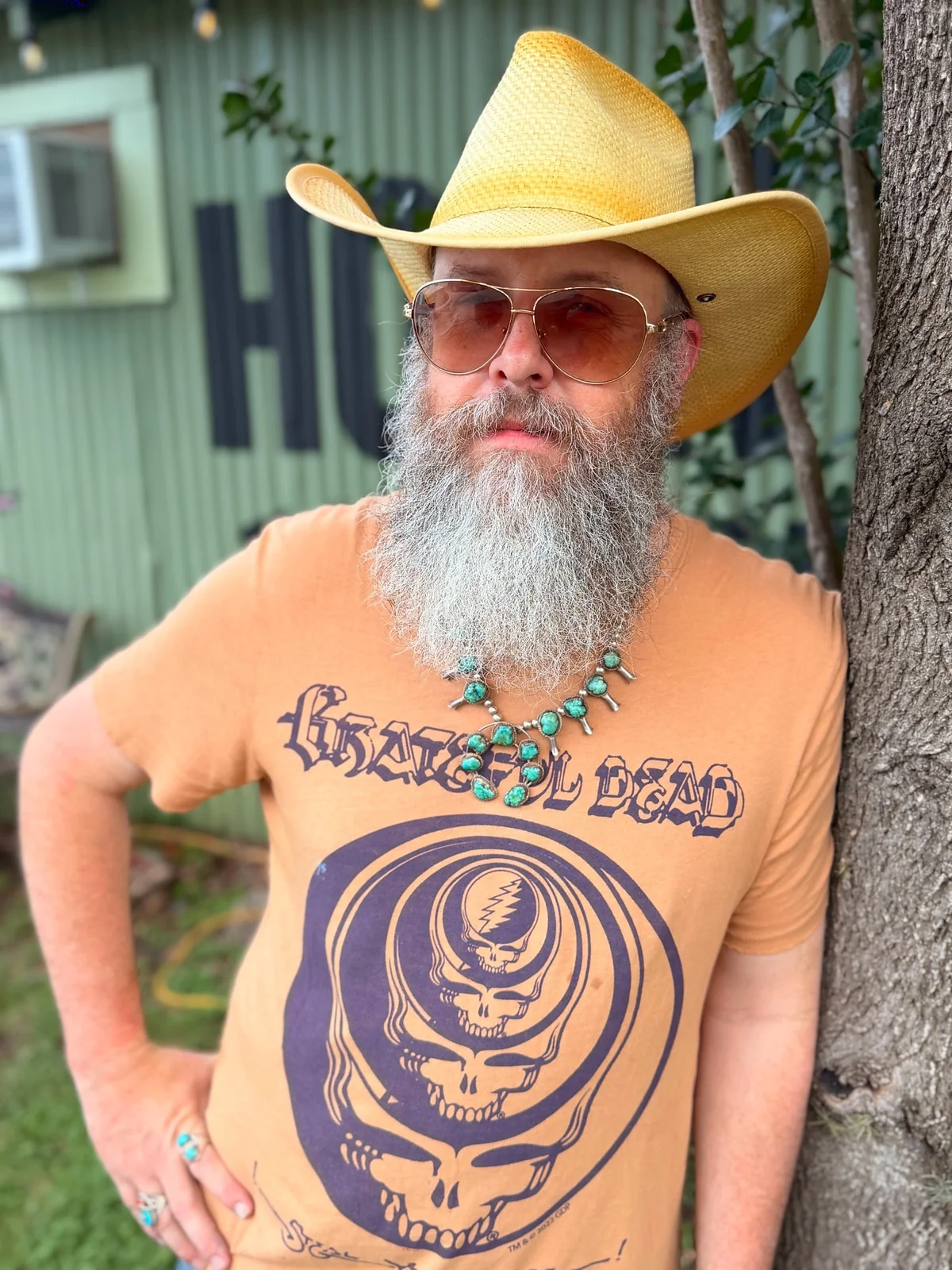
The Tomball Sound: The Texas Songwriter Who Built His Own Little Honky Tonk and Started Something really Big
In a small town outside Houston, Michael Dean Pierce Jr. is helping build a musical culture where original songs matter more than fame, the characters are as colorful as the lyrics, and the smallest honky tonk in Texas might be home to one of the state's most interesting grassroots music experiments.
TOMBALL, TEXAS.
There's a little green building tucked into the historic streets of Tomball that looks as though somebody picked it up out of 1955 and forgot to put it back.
Inside, the walls are crowded with vintage signs, old advertising, local memorabilia, and the accumulated peculiarities of a Texas past that refuses to disappear. There's neon, worn furniture, a stage barely big enough for the musicians, and, perhaps most appropriately, a gold-painted toilet.
Welcome to the Little Honky Tonk, billed as the smallest honky tonk in Texas.
It's part listening room, part time machine, part neighborhood clubhouse, and entirely uninterested in becoming another polished Nashville imitation.
The man behind it is Michael Dean Pierce Jr., an Oklahoma-born songwriter, musician, artist, entrepreneur, and community provocateur with an affection for old things, odd people, and songs that occasionally say what polite company would rather leave unsaid.
But the more interesting story isn't simply that Pierce built a tiny honky tonk.
It's that he helped give a new musical identity to a town.
They call it the Tomball Sound.
A Sound That Doesn't Ask Permission
Country music has never suffered from a shortage of rules. There are unwritten expectations about what a country singer should look like, how a country record should sound, and which subjects ought to stay safely within the boundaries of radio-friendly heartbreak.
The Tomball Sound doesn't seem particularly concerned with those boundaries.
Its musical vocabulary draws from traditional country, Texas honky-tonk, blues, folk storytelling, and the loose, unruly energy of musicians playing songs because they have something to say.
It is less a rigid genre than a shared philosophy.
The premise is simple: write your own songs, tell your own stories, bring your own personality, and don't sand away every rough edge trying to please somebody who isn't listening anyway.
In Pierce's songwriting world, humor and heartbreak are neighbors. So are religion and temptation, tenderness and vulgarity, affection and aggravation.
His 2026 album Gold or Dirt offers a particularly revealing map of that territory. Across 19 songs, titles such as "Wine & Cigarettes," "Holy Roller," "Oklahoma Son," "Many Beers Ago," "Proverbs 31 Chick," and "Welcome to the Shit Show" suggest a catalog that has little interest in maintaining a single respectable personality.
There is something very Texas about that contradiction.
It's the familiar collision of Sunday-morning morality and Saturday-night trouble. The person seeking salvation might well be the same person who caused the problem in the first place.
The title Gold or Dirt itself carries a question that could serve as a larger metaphor for the scene: What actually matters when the money, vanity, and decorations are stripped away?
The answer, at least in Tomball, seems to have something to do with the song.
If You Can't Find a Stage, Build One
The origin of the Little Honky Tonk is refreshingly uncomplicated.
Pierce wanted a place to play original music. Rather than wait for an established venue to make room, he created one himself.
What began around informal music-making and a shop became a dedicated performance space for original songs.
The building is small enough that performers and audiences share practically the same air. There is little room for the elaborate production, theatrical distance, or technological camouflage that has become standard in larger contemporary venues.
And that proximity changes the relationship between a songwriter and the people listening.
A funny song has to earn its laugh. A sad song has nowhere to hide. A story that loses its way is immediately exposed.
In the best circumstances, the little room becomes something that large venues spend fortunes trying to manufacture: an actual connection between the performer and the listener.
The no-cover-song philosophy is central to that identity.
This isn't a condemnation of musicians who play familiar favorites. It's a declaration that somebody has to make room for the next song nobody knows yet.
After all, every country standard was once an original song performed for an audience hearing it for the first time.
The Wonderful Weirdness of Michael Dean Pierce Jr.
Pierce's creative world extends well beyond his guitar.
Through Cloud Chief & Co., his Tomball shop, he has assembled a collection of curiosities, antiques, jewelry, oddities, and historical remnants that looks suspiciously like the contents of a songwriter's imagination.
His handmade and vintage-inspired concert posters borrow from the visual language of underground Texas music culture: weathered lettering, irreverent cartoons, strange mascots, faded colors, and humor that occasionally wanders into gloriously questionable territory.
The artwork is not merely advertising. It gives the music a visual identity.
And there is a genuine connection between the way Pierce approaches art and the kind of songs associated with the Tomball Sound.
Neither seems interested in immaculate surfaces.
A crooked line can have personality. A worn-out object can carry a story. A rough-edged lyric can say something that a carefully polished one cannot.
That attitude has helped create a distinctive atmosphere around the performances.
The Little Honky Tonk has the sensibility of an old-fashioned Texas gathering place, but it also carries some of the independent spirit of the Austin music scene of the 1970s, when musicians, artists, outsiders, and eccentrics were still figuring out what their shared culture might become.
The comparison isn't about commercial scale. Tomball is not Austin, and the Little Honky Tonk is not trying to be the Armadillo World Headquarters.
It's about something more fundamental: allowing a creative identity to grow from the people who actually live there.
More Than a Band
One of the more promising aspects of the Tomball Sound is that Pierce hasn't treated it solely as the name of his personal musical project.
The evolving Cloud Chief & Friends performances bring other musicians into the equation. Larger band configurations, collaborations, and live recordings suggest an interest in creating something that can grow beyond one songwriter standing in front of a microphone.
In 2026, Pierce released The Tomball Sound, a five-song collection on Tomball Records, alongside live material recorded at the Little Honky Tonk.
The existence of those records matters.
A local music scene becomes more than a series of enjoyable evenings when its songs begin to exist outside the room in which they were performed. Recordings allow the music to travel, accumulate an audience, and eventually tell the story of a particular place and time.
And there is an appealing refusal to separate the recording artist from the town that gave the project its identity.
Even the titles tell you where the songwriter's attention lies: "Marfa," "Oklahoma Son," "Smallest Honktonk in Texas," "This Old Trailer," and "Guitar Case."
These are not titles assembled by a marketing committee attempting to reverse-engineer a streaming hit.
They suggest places, objects, people, and complicated lives.
The challenge ahead will be making the musical identity as unmistakable as the visual one, developing a body of recordings that listeners can recognize as the Tomball Sound without needing to read the album cover.
That kind of identity takes time, and it requires more than one artist.
But the ingredients are there.
Where the Music and the Town Meet
The cultural experiment doesn't stop when the instruments go back into their cases.
Around historic Tomball, the same independent-minded energy reaches into art markets, local businesses, neighborhood events, eccentric celebrations, and a small network of places where people still gather face-to-face.
Pierce's involvement in the local art and makers market reflects a broader conviction that creative activity belongs in the everyday life of a town, not merely behind the doors of galleries and concert halls.
Musicians need audiences. Artists need buyers. Independent businesses need foot traffic. And communities need places where strangers can become regulars.
Those relationships are the infrastructure of culture, even when nobody thinks to call them that.
The gold-painted toilet at the Little Honky Tonk may be the most wonderfully ridiculous illustration of the idea.
When the venue needed a restroom, community support helped make it happen. What might otherwise have been a mundane building requirement became another piece of local folklore.
There is a lesson somewhere in the absurdity.
A music scene isn't built only by the person holding the guitar. It's built by the people who show up, contribute, help, laugh, listen, and return.
That might ultimately be the most significant thing taking shape in Tomball: a culture of participation rather than passive consumption.
The Next Chapter of the Tomball Sound
Of course, creating a distinct local sound is one thing. Getting the rest of the world to notice it is another.
Texas has produced plenty of artists who began far from the centers of the recording industry. Some eventually became famous. Others remained regional legends, enormously important to the people who actually heard them and almost invisible elsewhere.
There is no guarantee which direction the Tomball Sound will take.
Its future will depend on the quality of the songs, the consistency of the recordings, the musicians who join the circle, and whether the community continues to make room for its own original voices.
But that's what makes the undertaking interesting.
Pierce isn't waiting for a record company to announce that Tomball has a sound. He's using that name, putting songs behind it, giving musicians a stage, and asking the public to participate in defining what it means.
There is both audacity and charm in the proposition.
A little green building. A roomful of people. Some guitars. Original songs. A collection of handmade posters. An expanding cast of local characters. A toilet painted gold.
None of it looks especially calculated.
And perhaps that's the point.
Country music has always been at its most compelling when it remembers that its stories belong to ordinary people living extraordinary, ridiculous, difficult, beautiful lives.
In Tomball, Michael Dean Pierce Jr. and his circle of musicians are attempting to build a culture around that old idea.
They haven't conquered the music business.
They've done something more immediate.
They've made a place where their music belongs.
And sometimes, that's where a sound begins.
The Tomball Sound. Tomball, Texas. Original music from the smallest little honky tonk in the state.
THE MAN WHO KEPT INVITING TOMBALL TO TOMBALL
The posts, the posters, the peculiarities, and the occasional online dust-up of Michael Dean Pierce Jr., a man who somehow turned “Come visit downtown” into an ongoing civic adventure.
TOMBALL, TEXAS. There are easier ways to spend your days than trying to convince a town to come out and enjoy itself. You could take up fishing. You could learn to keep your opinions off Facebook. You could sit quietly on a porch and avoid ever mentioning a local festival, a historic building, a handmade poster, or the fact that a perfectly good Saturday afternoon is being wasted indoors.
Michael Dean Pierce Jr. has apparently considered none of these options.
An Oklahoma-born songwriter with a cowboy hat, an eye for the unusual, and an almost supernatural ability to turn a local invitation into a conversation, Pierce has made a small mission out of a very simple proposition: Visit Tomball. Shop Tomball. Hear some music. Meet your neighbors. Have a little fun.
It sounds harmless enough. In his hands, it occasionally becomes an entire production.
THE FACEBOOK FRONTIER
Pierce became a familiar presence in Tomball's online community by posting about downtown businesses, artists, festivals, local history, music, and whatever else might get somebody off the couch and onto Main Street. The posts could be enthusiastic, irreverent, nostalgic, or delightfully hard to categorize. They were seldom designed by a committee.
Facebook, meanwhile, has its own peculiar sense of humor. Pierce has talked about disappearing posts, platform headaches, and losing access to monetization that had once made his online storytelling more than just a hobby. He gave the automated systems a nickname worthy of an old slapstick comedy: the “Keystone Bots.”
At one point he entertained a whole menu of explanations for his Facebook troubles. Was it the algorithm reacting to unusually lively local reach? Had his unfiltered commentary made somebody uncomfortable? Or was the shadowy “Tomball Illuminati” at work?
That last one belongs squarely in the joke column. There is no reason to treat a secret society of downtown gatekeepers as an established fact. But as a running bit, it captures something wonderfully familiar about small-town life: promote the town loudly enough, and sooner or later you may find yourself wondering how a welcome sign became a controversy.
Pierce's recurring question was less complicated: How did simply inviting Tomball to Tomball get to be such an adventure?
TOO MANY IDEAS FOR ONE MAIN STREET
To understand the commotion, it helps to understand the inventory. Pierce and his wife, Dion, are partners in Cloud Chief & Co., a Main Street shop devoted to curiosities, turquoise jewelry, oddities, vintage treasures, and objects with a story to tell. He also helps bring the Tomball Art & Makers Market to life, giving local makers and artists a reason to set up shop and visitors a reason to wander downtown.
Then there is The Little Honky Tonk, a tiny green performance space where original songs get top billing, the room is small enough to hear a singer breathe, and the gold-painted toilet has nearly achieved the status of a supporting character.
For Pierce, these aren't unrelated projects. A person who comes downtown for a piece of art might stay for dinner. Someone shopping on Main Street might discover a songwriter. A visitor who came for a concert might realize there is a whole historic district worth exploring.
That is his version of economic development: one interesting doorway leading to another.
Naturally, it comes with posters. Lots of posters.
WANTED: PEOPLE WILLING TO HAVE A GOOD TIME
Pierce's handmade-style artwork rarely whispers. There are vintage Western melodramas, absurd characters, outrageous slogans, train tracks, dancing barns, and the occasional flying pig. His Tomball-themed game sends players through a cartoon universe where guitars are treasures and even trouble has a soundtrack.
He once developed a poster urging people to save historic Old Tomball, complete with a woman in distress, an approaching train, and an entire roster of reasons to visit: shopping, eating, listening, strolling, art, and culture. It is civic enthusiasm delivered with the visual subtlety of a Saturday matinee.
And that is precisely the point. He is not selling a tidy brochure version of Tomball. He is selling the characters, odd buildings, old signs, stubborn shopkeepers, unusual musicians, and unpredictable conversations that make a place feel alive.
Some people enjoy that sort of enthusiasm. Others would probably prefer it arrive in a smaller font.
THE TROUBLE WITH HAVING A PERSONALITY
There is a fine line between a community booster and a community character. Pierce has spent years walking it in cowboy boots.
His online voice can be sharp, funny, skeptical of bureaucracy, and happily resistant to polished civic messaging. He has also raised eyebrows with his fascination for local lore, including his oft-repeated observation about Tomball's namesake and whether the man ever set foot in the town that bears his name. It is the kind of historical question that can turn a sleepy comment thread into a full-blown porch debate.
None of that means every argument has a villain or every Facebook mishap has a conspiracy behind it. Often it means only that a colorful person has met the internet, an invention uniquely talented at confusing jokes with declarations and enthusiasm with agitation.
Pierce's best defense is also his guiding principle: he keeps showing up. There are musicians to introduce, a market to host, a new sign to hang, a picture to post, and another invitation to send.
A TOWN IS NOT A COMMENT SECTION
Underneath the jokes sits a sincere idea about what a historic downtown should be.
It should not be a collection of pretty facades that people drive past. It should be a place where people do things. Where they buy something from a neighbor. Where an original song is heard for the first time. Where an artist sells a painting, a visitor finds an odd little shop, and somebody leaves knowing a name they didn't know when they arrived.
That is why Pierce keeps pushing, posting, designing, playing, and occasionally raising a little dust. The larger story isn't about beating an algorithm or winning the last word in a Facebook argument. It is about turning online attention into actual footsteps on actual Tomball sidewalks.
The result is a local legend still in progress: one part songwriter, one part shopkeeper, one part poster artist, and one part unofficial downtown town crier.
Ask Pierce what he is trying to accomplish and the answer is not especially mysterious.
He wants people to come to Tomball.
He wants them to discover why it is worth coming back.
And if he has to stir up a little conversation along the way, well, at least somebody is talking about Tomball.
Michael Dean Pierce Jr. is a songwriter and musician associated with the Tomball Sound, Cloud Chief & Co., and The Little Honky Tonk in historic Tomball, Texas.
★ A TOMBALL TALL TALE ★
The Myth of Michael Dean Pierce Jr.: The Man Who Invited a Town to Its Own Party
A Texas tall tale, told with a straight face and a crooked grin. What follows is folklore for entertainment, not a claim that any impossible event actually occurred.
AS TOLD IN TOMBALL, TEXAS. Nobody can say for certain where the story first began. Some insist it was at the counter of a curiosity shop. Others claim it started the night the gold toilet was installed. The sensible folks say that if you want exact history, you have chosen the wrong tab.
The Day the Map Went Missing
In certain corners of historic Tomball, people tell a story about Michael Dean Pierce Jr. It begins, as the best Texas stories do, with a fellow who was supposed to be doing something sensible and instead got an idea that was far too large for the room he was standing in.
According to the tale, Pierce spread a map of Tomball across the counter of Cloud Chief & Co., the curiosity shop he and his wife Dion built together. He looked at Main Street, at the older buildings, at the spaces between one neighbor and the next, and decided the map was missing something important.
It had roads, yes. It had addresses and intersections. What it did not have, he declared, was enough reasons for a person to get out of the truck.
So he took up a pen and started adding things no cartographer would recognize: a guitar, a paintbrush, a plate of barbecue, a turquoise stone, a fellow selling pottery, and a little green building with music spilling out the windows. By supper, the legend says, the map looked less like a town and more like the invitation to a party no one was allowed to leave early.
Dion reportedly took one look at the masterpiece and asked the only practical question in the county: “Who is going to set all this up?”
“We are,” he said. And, as anyone who has started a small business with a spouse knows, that is where the real adventure begins.
The Smallest Kingdom in Texas
Every king needs a castle. Pierce, being the sort of fellow who regards ordinary castles as a waste of good parking space, settled on The Little Honky Tonk: a green music room with thirty-nine numbered seats and an amount of personality that would require a building permit in a larger town.
He did not fill it with cover songs, velvet ropes, or a giant stage. He filled it with original music. A songwriter could step up, tell the truth as they understood it, and find out in real time whether a room full of Texans believed them.
The acoustics were reportedly so intimate that you could hear a guitar string reconsider its life choices. A sad ballad could quiet the whole room. A funny line could rattle the old signs. And when the songs got particularly good, the green building was said to lean an inch toward Main Street so the rest of Tomball might hear.
In the corner of this unlikely kingdom sat its most famous throne: a toilet painted gold. Nobody entirely agrees when it became a symbol of the place. Some say it was civic generosity. Others insist a visiting angel mistook it for a piece of stage equipment. Either way, it is hard to take yourself too seriously in a music hall whose royal seat has plumbing.
Pierce, naturally, took this as proof that the enterprise was headed in the right direction.
The Great Tomball Invitation
The story gets stranger when Pierce discovers the town does not necessarily know it has been invited to itself.
He tells people to visit the shops. He tells them to meet the makers. He tells them to listen to original songs, buy somebody’s art, and enjoy the peculiar miracle of a Texas downtown where the shopkeeper might also be the guitarist and the fellow drawing the poster.
He makes flyers that look rescued from an abandoned picture palace. He invents cartoon characters, flying barns, impossible angels, and outrageous slogans. He even helps make a game in which a honky tonk survives by collecting guitars and dodging the troubles of modern life. At a certain point the distinction between civic promotion and a one-man traveling carnival becomes purely academic.
One afternoon, according to absolutely no official record, Pierce stood on Commerce Street, shouted “COME TO TOMBALL!” and received an echo from so many directions that the railroad crossing rang its bells in approval.
The story also claims that his Facebook posts were so frequent that a machine somewhere began to dream of turquoise jewelry and gold toilets. The machine, alarmed, filed a complaint with another machine. Pierce responded by designing a better poster.
Whether that part happened precisely as told is beside the point. Even the mythical Michael has the same practical objective as the real one: turn a screen full of spectators into a sidewalk full of people.
The First Lady of the Republic of Odd
Of course, no one builds a tiny cultural republic alone. In the fable, Dion is the keeper of the keys, the finder of missing receipts, the person who remembers what time things are meant to begin, and the one person who can tell Michael when an idea is wonderfully ridiculous rather than merely ridiculous.
Together, they keep Cloud Chief & Co. alive with strange treasures, old objects, turquoise, curiosities, and stories that arrive without price tags. The shop becomes the unofficial embassy of this imagined republic, a place where visitors can acquire a piece of history and leave with directions to the next adventure.
The myth gives Michael all the loud declarations, but it gives Dion something much rarer: the good sense and partnership that allow a declaration to become a real place. That is why the folklore never says he did it alone.
The Tomball Sound Travels Without Leaving Home
Soon enough, the musicians arrive. Some carry fiddle cases. Some carry guitars with scars and stories. A few arrive with songs nobody has ever heard, which in this kingdom is a greater credential than a radio hit.
Pierce calls the gathering the Tomball Sound, not because every instrument must sound alike, but because all those different voices have agreed that their songs belong somewhere.
The legend says the music rises over Commerce Street on Friday nights, passes over the old storefronts, and catches in the branches of trees outside town. By morning, somebody miles away wakes up humming a chorus they cannot explain. They drive to Tomball to find it, buy lunch, wander through the market, discover Cloud Chief, and eventually locate a green building small enough to be overlooked but too peculiar to forget.
This, of course, is the only kind of music business plan that makes sense in a true Texas fable: give people something worth hearing and trust the song to bring them back.
The Town That Might Become a Story
Old Hondo Crouch became part of the folklore of Luckenbach by proving that a Texas place could be both real geography and an enormous wink. Pierce’s imaginary counterpart is after a related sort of magic, though his version comes with more artwork, more guitars, and considerably more digital trouble.
He is not trying to build a monument to himself. The grand ambition, beneath the cowboy hat and the tall tales, is to build a place that makes other people interesting: a songwriter gets heard, an artist gets discovered, a small business meets a new customer, and neighbors find a reason to come back next Saturday.
No one knows how large the Tomball Sound might grow. Perhaps it becomes a footnote in Texas music history. Perhaps years from now someone points at a weathered photograph and says, “That was the little green hall where something started.” Perhaps the whole thing remains gloriously small.
But should you ever hear that a cowboy in a bright hat has been seen dragging the entire town of Tomball toward a party it did not know it was hosting, do not call the sheriff. Check the calendar.
There is probably a show at eight.
And if the myth contains a kernel of truth, you will not find it in the exaggerations. You will find it when the room fills up, somebody plays an original song, and a stranger decides Tomball is worth another visit.
★ THE MORAL OF THE STORY ★THE TOWN IS REAL. THE MUSIC IS REAL. THE REST IS GETTING BIGGER WITH EVERY TELLING.